Program Overview
The Food Business Microgrant Program supports the recovery and expansion of shared‑use commercial kitchen capacity in Orleans Parish following the damage caused by Hurricane Ida, including the loss of facilities such as Edible Enterprises. The program provides microgrants for the rehabilitation, reconstruction, expansion, or construction of commissary kitchens to stabilize and increase access for food entrepreneurs.
Funding is provided through HUD CDBG‑Disaster Recovery (DR) funds awarded to the City of New Orleans through the State’s Resilient Communities Infrastructure Program (RCIP). NORA serves as the Subrecipient and administers the Microgrant Program on the City’s behalf.
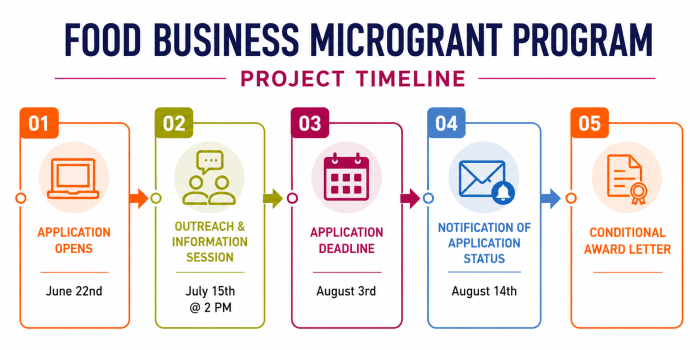
Applications open on June 22, 2026.
Projects must be located within Orleans Parish and serve food entrepreneurs operating in New Orleans.
Eligible areas must meet the low‑to‑moderate income (LMI) area benefit requirement (at least 51% LMI residents), as documented in the HUD‑approved RCIP application.
Eligible applicants must:
- Be a nonprofit or for‑profit entity that:
- Currently operates a commissary kitchen in Orleans Parish, or
- Has a well‑developed, actionable plan to establish one.
- Be in good standing with the City of New Orleans (no outstanding debts).
- Hold an Occupational License, if applicable.
- Be authorized to do business in Louisiana and in good standing with the Secretary of State.
- Be authorized to do business with the Federal Government.
Eligible improvements must support safe, functional, and code‑compliant commissary kitchen operations. Eligible activities generally include upgrades to building systems such as electrical, plumbing, and mechanical components; improvements to ventilation and fire safety; sanitation and surface upgrades required for commercial food preparation; and installation of fixed, immovable commercial kitchen equipment. Examples include electrical and plumbing upgrades, grease traps, commercial water heaters, and other infrastructure needed for commercial kitchen loads. Improvements may also include required ventilation systems and fire‑safety elements such as Type I hoods, make‑up air systems, fire suppression systems, and associated ductwork.
Sanitation‑related improvements may include commercial‑grade sinks, dishwashing equipment, washable wall surfaces, and appropriate non‑slip flooring. Fixed and permanently installed kitchen equipment—such as ranges, ovens, fryers, walk‑in coolers, freezers, and other built‑in appliances—is also eligible when essential to kitchen operations. Accessibility improvements, including widened doorways, ramps, and lowered work surfaces, are eligible when required to meet ADA standards. Projects may also incorporate shared‑use resources such as built‑in storage, shared fixed equipment, and other infrastructure that supports multiple kitchen users.
Maximum Grant Amount
- Up to $400,000 per project
Coverage
- May cover up to 100% of eligible costs (not exceeding $400,000)
Part 1: Pre‑Application
Required submissions:- Applicant & business information
- Proof of kitchen operations or kitchen plan
- Photos of existing space
- Owner consent or proof of ownership
- High‑level project description, cost estimate, request amount
- Financial documents
- Disaster recovery/resilience background (if applicable)
- Certification of accuracy and non‑duplication of benefits
Technical Assistance Phase
Applicants who pass pre‑application are required to work with Technical Assistance (TA) providers to:
- Refine project scope
- Prepare the full application
- Strengthen business and operational plans
Part 2: Full Application
Full applications must include:
- Business & Operations
- Comprehensive business plan
- Financial statements
- Proof of financing for any non‑grant costs
Project Scope & Feasibility
-
Detailed scope of work
-
Design/layout documents
-
Two contractor estimates (10% contingency recommended)
-
Project timeline & permitting plan
-
Financial need justification
Community Impact
-
Current & projected number of kitchen users
-
Access for underserved food entrepreneurs
-
Community benefit documentation
Disaster Recovery Alignment
- Resilience measures (flood mitigation, drainage, etc.)
All funds are disbursed on a reimbursement basis.
- Participant contributions must be spent first
- Up to 4 reimbursement requests allowed
Documentation required:
- Invoices
- Lien waivers
- Permits
- Evidence of completed work
Inspection & Payment Processing
- NORA inspects prior to reimbursement
- Payments processed within 45 days of complete request
- For projects over $50,000, up to $5,000 may be withheld until final verification (COO if applicable)
Submission Deadlines
- All reimbursement requests due within 6 months of project completion
This is a cost‑reimbursement program.
• NORA will conduct compliance inspections at Year 1, Year 3, and Year 5
• Kitchens must remain operational throughout the Regulatory Period
• Non‑compliance may result in recapture of funds
Operational Readiness Requirements
- Facility must be occupancy‑ready within six (6) months of grant agreement execution.
- Facility must obtain a Certificate of Occupancy from the City of New Orleans.
- Kitchens without tenants at project completion must begin accepting tenants within twelve (12) months.
- Failure to meet these readiness requirements may result in a 10% penalty, requiring repayment of 10% of the total grant funds disbursed.
Maintenance & Compliance Requirements
- All funded improvements must be maintained in good condition for a Regulatory Period of three (3) to five (5) years, depending on project scope and tier.
- The commissary kitchen must remain operational and in compliance with program guidelines throughout the Regulatory Period.
- NORA will conduct compliance inspections at approximately Year 1, Year 3, and Year 5.
- Failure to maintain improvements or continue operations may result in grant recapture.
Recapture of Grant Funds
NORA may recapture a portion or all the grant funds if:
- Improvements are altered, removed, destroyed, or not properly maintained during the Regulatory Period.
- The facility ceases operations in violation of program requirements.
- The project is not completed according to the approved scope of work.
- A duplication of benefits is identified (e.g., another source also funded the same improvements).
Pro‑Rata Recapture:
- Recapture may be applied on a pro‑rated basis, reducing the recoverable amount by one‑fifth (1/5) for each full year the recipient remains in compliant operation during the five‑year period.
NORA may recapture funds if:
- Improvements are altered, removed, or not maintained
- The kitchen ceases operations during the Regulatory Period
- Duplication of benefits is identified
- The project is not completed according to the approved scope
Recapture may be prorated by one‑fifth per compliant year.
Applications should be submitted online via the Webgrants portal: https://nora.webgrantscloud.com/. First, you’ll need to register for a WebGrants account. Once your account is set up, go to Funding Opportunities and select the Food Microgrant opportunity. Please note that paper applications are not available and will not be accepted.
Contact Information:
Economic Development Program Manager
This email address is being protected from spambots. You need JavaScript enabled to view it.
504-658-4451
Kathryn “KK” Welty
Project Coordinator
This email address is being protected from spambots. You need JavaScript enabled to view it.
504-658-4444

New Orleans, LA 70113
P: 504.658.4400 • F: 504.658.4551

